
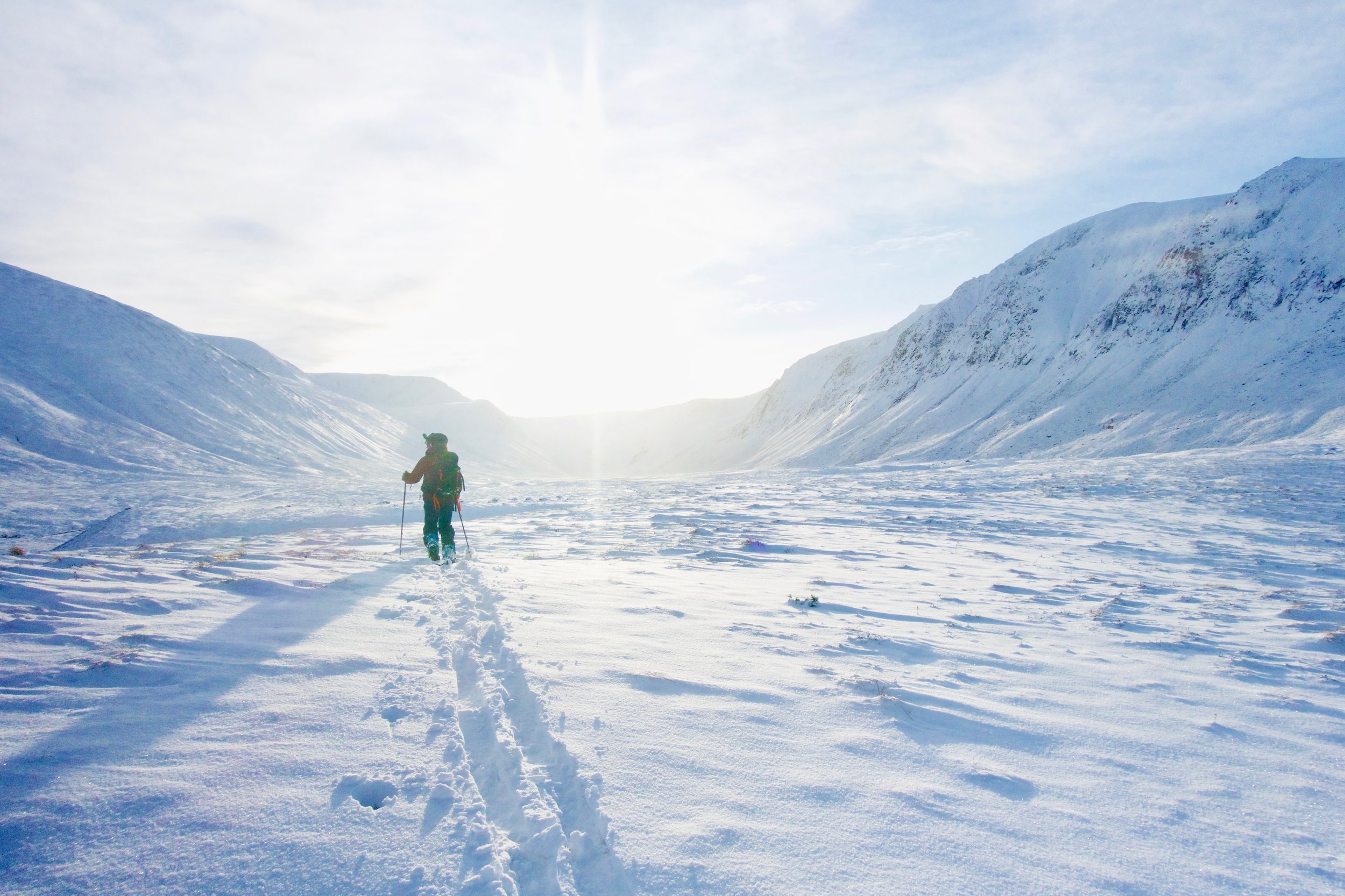
BACKCOUNTRY TOURING & SPLITBOARDING


SNOWSMART
FORECAST

QUALS

AVALANCHE
LIBRARY
Backcountry snowsports are those that take place in off-piste unpatrolled terrain outside a ski resort boundary. Snowsports activities that take place off-piste but within a ski resort boundary are known as sidecountry snowsports.
When in either of these off-piste environments you can journey across snow using either touring skis, a splitboard or snowshoes. If you encounter icy patches you might also need boot or ski crampons to allow you to maintain grip safely.
Touring skis and splitboards enable you to attach “skins” to their sole to allow you to ascend as well as descend. This gives you complete freedom to choose your own route and enjoy the very best of the Scottish winter mountain landscape, away from the crowds and queues of the ski resort.
WHAT ARE BACKCOUNTRY SNOWSPORTS?

SKI TOURING
Put simply, ski touring is a blend of cross-country skiing and off-piste downhill skiing, but, rather than relying on lifts to get you up the mountain you use specialist equipment allowing you to do what’s known as ‘skinning’.
Skinning is the technique of moving uphill on your skis in a gliding motion, using ‘grippy skins’ attached to the soles of your skis. This will give you the freedom to explore far beyond the confines of the pistes and once you’ve reached the top of that perfect line, it’s yours for the taking.
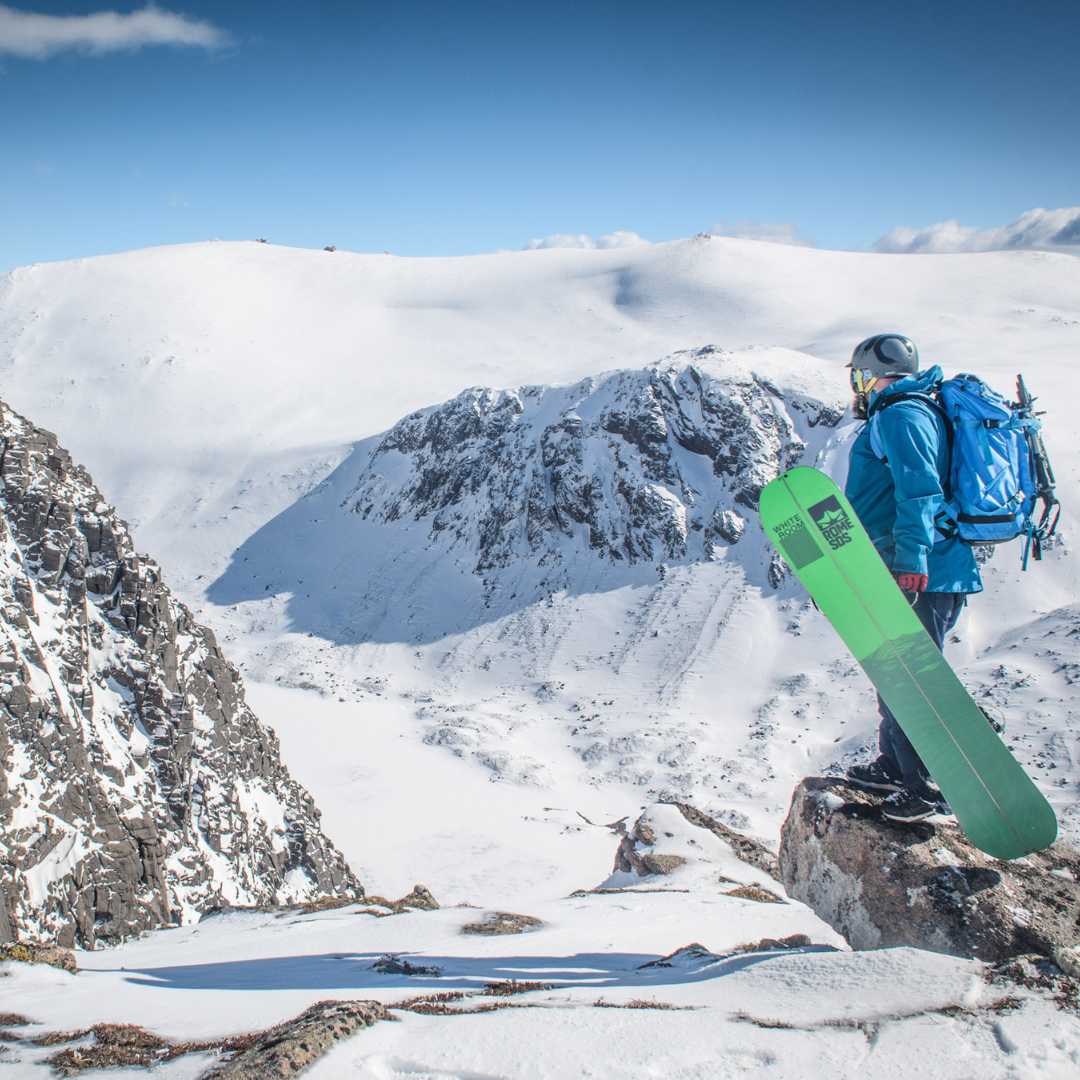
SPLITBOARDING
A splitboard is essentially a normal snowboard which splits into two halves. These halves become skis for travelling uphill, or touring. To enable the rider to walk uphill, adhesive-backed ‘skins’ are attached to the base of the skis to provide traction on the snow.Once at the top of the slope, the rider removes the skins, attaches the two skis together and it transforms back into a snowboard, ready for a well-earned descent through untracked powder.
WHERE CAN YOU DO IT?
You can go ski touring and splitboarding almost anywhere you can find snow. This is why it is enjoyed by so many, as a means to explore and get in some turns, when the pistes are too thin, and the uplifts are closed.
There are some great guidebooks available offering many backcountry touring routes for you to enjoy - see the footer section for more on this.
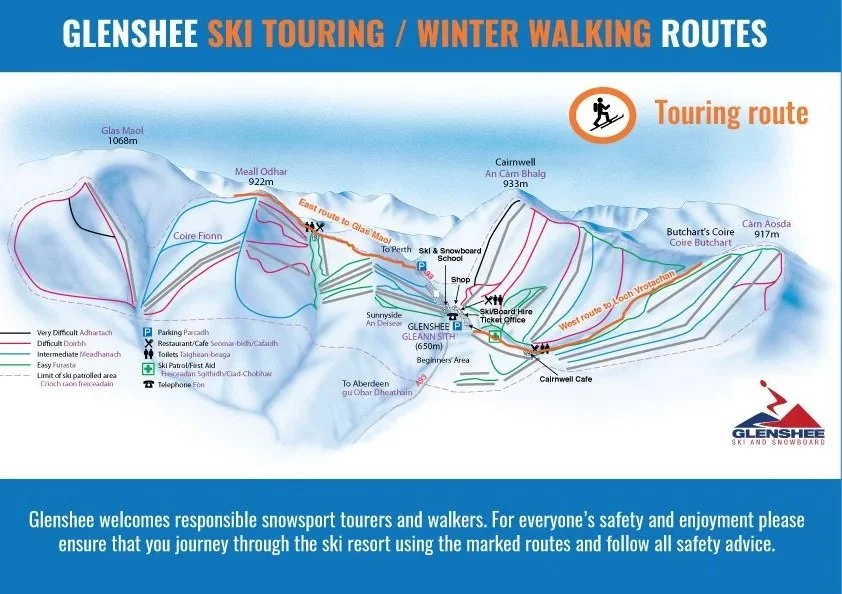
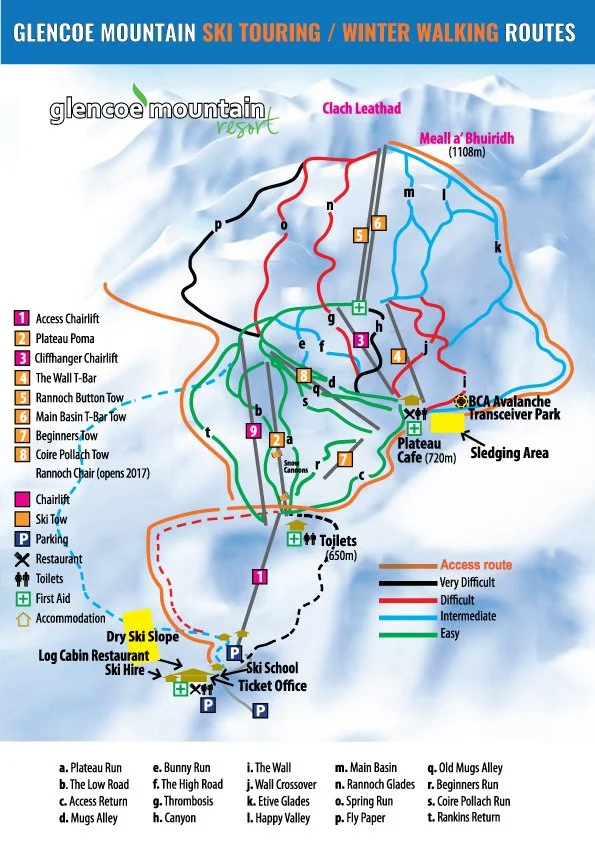
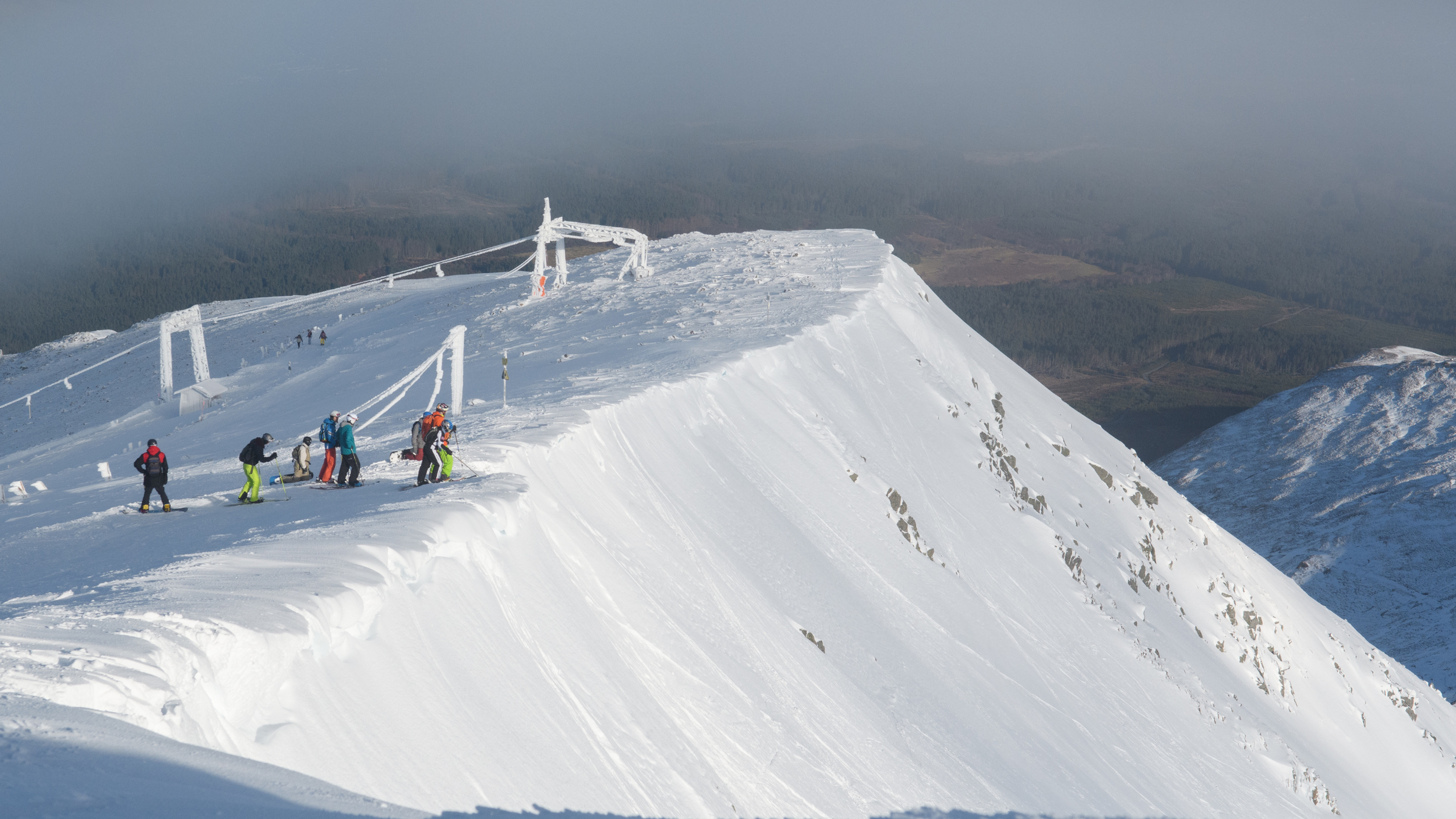
If you have never been out touring in the side or backcountry before, a good place to get started is in Scotland’s ski areas, where there is parking at a high level and clear signage to help you know where to go. They welcome tourers and you can even get a tourers pass for some uplift to assistance.
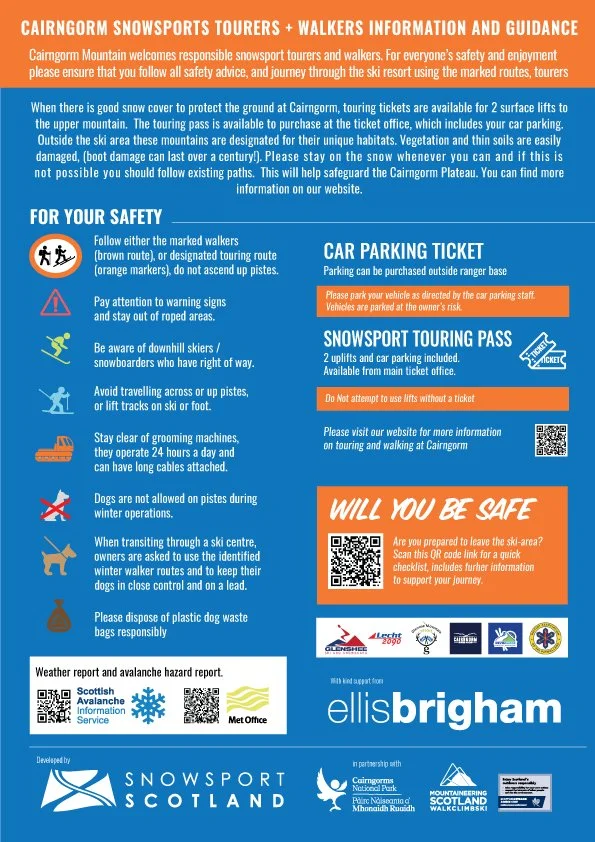
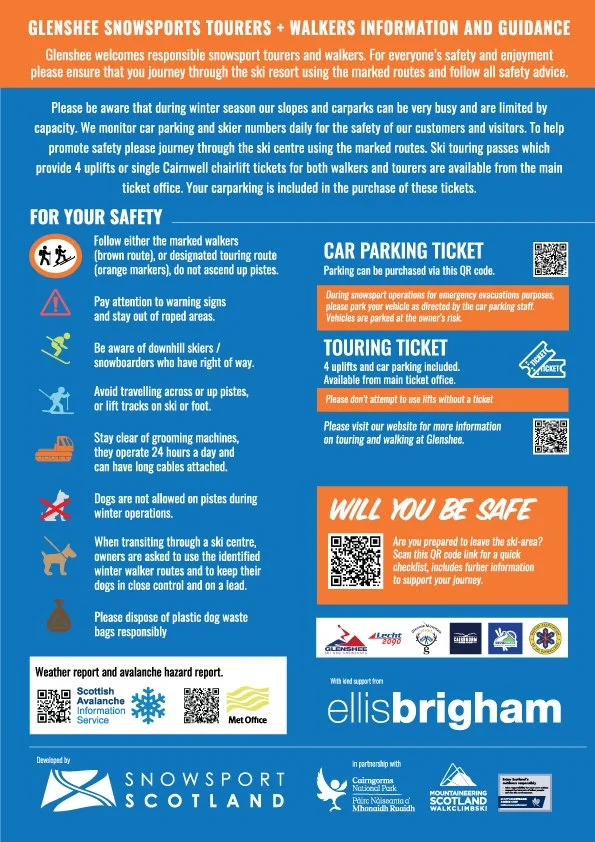
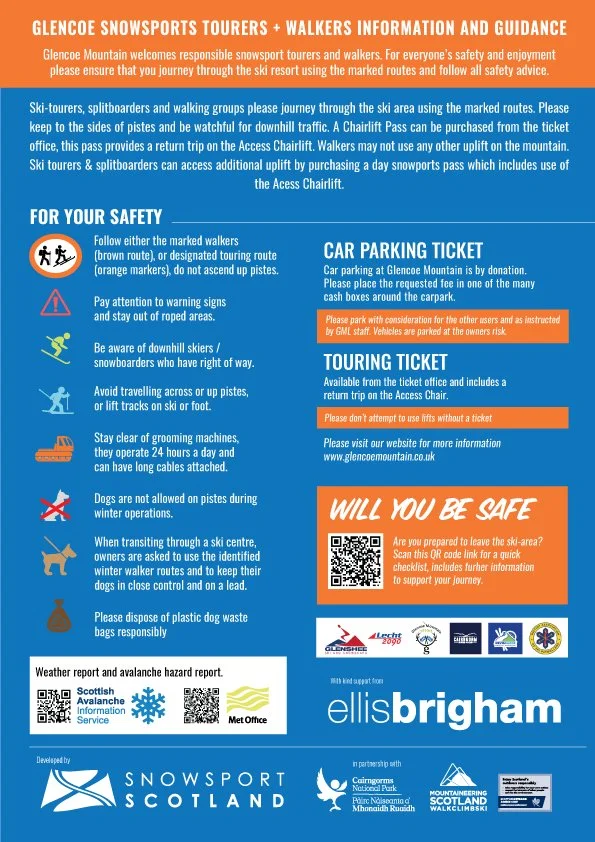
Below are images of the in-resort signage showing touring routes. Keep you eyes open for them.
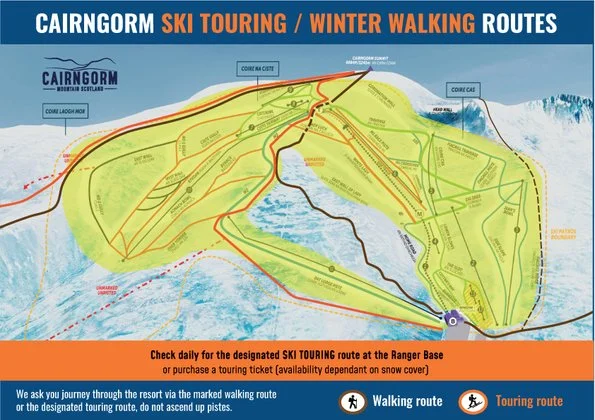

IN-RESORT TOURING CODE
When journeying though any of Scotland’s managed ski areas, all tourers are expected to adhere to the Snowsports Touring Code and:-
- Follow the designated access routes (orange markers)
- Do not ascend up pistes.
- Pay attention to warning signs and stay out of roped areas.
- Be aware of downhill skiers/snowboarders who have right of way.
- Avoid travelling across or up pistes, or lift tracks on ski or foot.
- Stay clear of grooming machines, they operate 24 hours a day and can have long cables attached.
- Dogs are not allowed on pistes when the resort is open.
- Please dispose of plastic dog waste bags responsibly.
BACKCOUNTRY HAZARDS
The Scottish backcountry environment can be a hazardous place where conditions can change quickly and self-reliance is necessary.
There is no ski patrol or immediate help at hand so if you’ve never ventured out into this environment before we strongly recommend going with someone who has. They can help you with learning about equipment, navigation and the natural hazards that you might encounter.
To help you find out what you know, as a start try our free online learning resource, SNOWSMART which will help you self-assess your skills and mountain safety knowledge for both the on and off-piste mountain environments. Using this SNOWSMART assessment will not only let you understand what you do and don’t know, but it also allow you to become approved for public liability insurance through Snowsport Scotland.
Although not designed to replace appropriate tuition, our Snowsmart e-assessment tools will help you build knowledge and confidence.
Click the logo below to get started and get smarter on mountain safety!

We also recommend that you have a look at #ThinkWINTER, established by Mountaineering Scotland. It is about promoting safe, responsible, and enjoyable mountain activities for everyone. #ThinkWINTER encourages awareness of slope responsibility, respect for others, and smart decision-making on the mountain. Whether you’re new to the slopes or highly experienced, #ThinkWINTER reminds us that safety, respect, and enjoyment go hand in hand
GETTING STARTED
Backcountry requires multiple skills due to its environment setting. Because of the broad skillset required it is good to take your first forays supported by someone who you trust or a guided tour to give you a good introduction. Choosing a good day and the best place to be on the mountain makes all the difference. This could be the difference between fun snow or icy slopes, the difference between playing or surviving, or the difference between celebrating or spending the night out. A reasonable on piste standard of skiing or snowboarding competence is required to make safe descents in variable non-groomed snow.
To safely enjoy riding in the backcountry, be it snowboarding or skiing, the user should be comfortable making turns in variable snow conditions and have an ability to find the safest and most enjoyable snow on offer that day. If still improving your backcountry riding then it is highly beneficial to have professional input which in turn helps increase your enjoyment, efficiency and safety.
We have also developed a comprehensive library of online videos to also help you get into, or find out more on backcountry:
6 KEY CONSIDERATIONS
Before heading out on your epic adventure - it’s important you consider these 6 questions:
-
Make a plan and ask yourself are you as a person prepared and capable to complete your plan?
A day out ski-touring or splitboarding can be tailored to every individual, perhaps a short lap in the ski-area, or an excursion to a remote Munro, but a good day out is one that is manageable by everyone in your group.
Our Backcountry essentials webinar has more info hereOur Fatmap Guidebook of routes including some good starting points in-resort
-
It’s generally good practice to head out with a partner or two, if anything or the company but also to have assistance when its needed.
The people that make up your group inform how your day will go. The skill level of the group may dictate your journey, as will fitness.
Group dynamics also extend to decision making, making good choices on route and snow relies on good group dynamics.Looking for a partner? Try British Backcountry on facebook
-
Being safe when travelling outside the confines of a ski area requires a multifaceted approach.
In terms of safety equipment a helmet is considered a fundamental.A Tranceiver, Shovel, Probe, are the basics you and each of your group require if you have to rescue one another from an avalanche.
Our partner Glenmore lodge has a video going through kit among other great resources here -
The weather can make or break a good day out. Do you have an up to date forecast?
-
There are no route markers or signs to keep you right in the backcountry. Navigation is a fundamental skill required to travel safely, particulary in whiteout condtions.
For nevigation skills see our partners - Mountaineering Scotland excellent resources
-
When is a slope safe from avalanches?
The Scottish Avalanche Information Service provides daily forecasts through winter at key areas
https://www.sais.gov.uk/
For a great education resource on travelling safely through avalanche terrain visit this page
EQUIPMENT
SKI TOURING
Touring skis have special touring bindings, these bindings allow the user to ski the skis just like alpine bindings do when skiing downhill. However, when it comes to “uphill” mode or skinning uphill, touring bindings allow the heal of the boot to be released but the toe stays attached. This allows the user to raise their heal and slide the ski along the snow all without lifting the ski from the snow.
To “slide” uphill you can attach “skins” to the sole of your skis or split snowboard. Touring skins are like natural animal fur in that they lay smooth and flat if brushed in one direction but are rough and grippy if pushed in the other direction. With skins attached to the bottom of the skis these enable the skis to grip the snow and not slide backwards as you ascend the slope.
SPLITBOARDING
Splitboards are snowboards which can be split into two, to make two splitboard “skis”. Each of these splitboard “skis” also has a similar sort of touring binding enabling you to lift your heel and slide in the same walking motion across the snow.
Once you reach your destination you simply remove the skins from the skis, lock the two halves back together, and then snowboard back down the hill as normal.
OTHER EQUIPMENT
Navigation, snow safety and mountain skills are fundamental to enjoying the backcountry and this presents further equipment consideration beyond the actual skis or snowboards. To find out more check out Glenmore Lodge’s video’s:

EDUCATORS

GLENMORE LODGE
Their staff share a passion and desire for wild skiing, taking their skills to the backcountry and enthusing others to do the same.
For beginners, check out their off piste courses. They also do a annual ‘Wild Ski Weekend’ open to all levels.
Each course provides a fitness and technical grading description to help you decide if this is the right course / level for you.

WANDERING WORKSHOPS
Based in Aviemore, Cairngorms, Wandering Workshops offers one day backcountry courses, covering: avalanche awareness and avoidance as well as backcountry skills.
It includes a basic introduction in to avalanche awareness and safety, including how to use avalanche safety gear.
These courses can also be used to count for Snowsport Scotland CPD.

BRITISH BACKCOUNTRY
British Backcountry offer ski touring days and skills courses.
Their mission is to introduce people to a more sustainable alternative to travelling abroad for snowsports, and to help participants become independent in the mountains.
They offer a host of skills/safety and intro days, as well as touring experiences and advanced skills in the backacountry - all based in Scotland.

WANT TO GET COMPETITIVE?
Upbattle is the biggest splitboarding event in the UK calendar, and is a weekend in the Cairngorm Mountains made up of action packed activity, seminars, demos and to top it all off the renowned ‘La Mans’ style derby race up the mountain. Whether you are an experienced backcountry adventurer or just have just started to explore the world of split boarding this event is not to be missed.
Although there is no formal pathway into competitive splitboarding, UpBattle are now offering workshops in technique and safety.
OTHER RESOURCES
Guidebooks:
- Scottish Offpiste Skiing & Snowboarding Glencoe: Kenny Biggin
- Scottish Offpiste Skiing & Snowboarding Nevis Range and Ben Nevis: Kenny Biggin
- Ski Mountaineering in Scotland SMC: Donald J. Bennet
- Skiing and Snowboarding in the Cairngorms: British Backcountry
Apps:
- View Ranger (Digital mapping compatible with smart phone)
- OS Mapping (Digital mapping compatible with smart phone & computer)
- Trailforks (Some ski area info, limited use)
Maps:
- Ordinance Survey & Harvies Maps cover all of the UK’s best skiing areas